Alternatives guide · Prices checked October 7, 2026
Loops Alternatives for SaaS Email: Prices and Fit
Pick Customer.io if you need event-heavy journeys across email, push and in-app; Userlist if the account, not the person, is the unit you message; Encharge if you want visual flows plus HubSpot or Salesforce syncing; and MailerLite or Kit if your emails are really newsletters and a short welcome series. Loops itself stays hard to beat on price for a small product: its free plan covers 4,000 sends a month, and paid plans start around $48 near 5,000 subscribers.
Loops is a focused tool, and most reasons to leave it are about a ceiling rather than a flaw. This guide starts from what Loops does and charges, then goes through each credible alternative with the prices its own pages show and the specific situation in which it beats Loops. For the head-to-head with the general-purpose option, see Loops vs Mailchimp.
What you are leaving: Loops in numbers
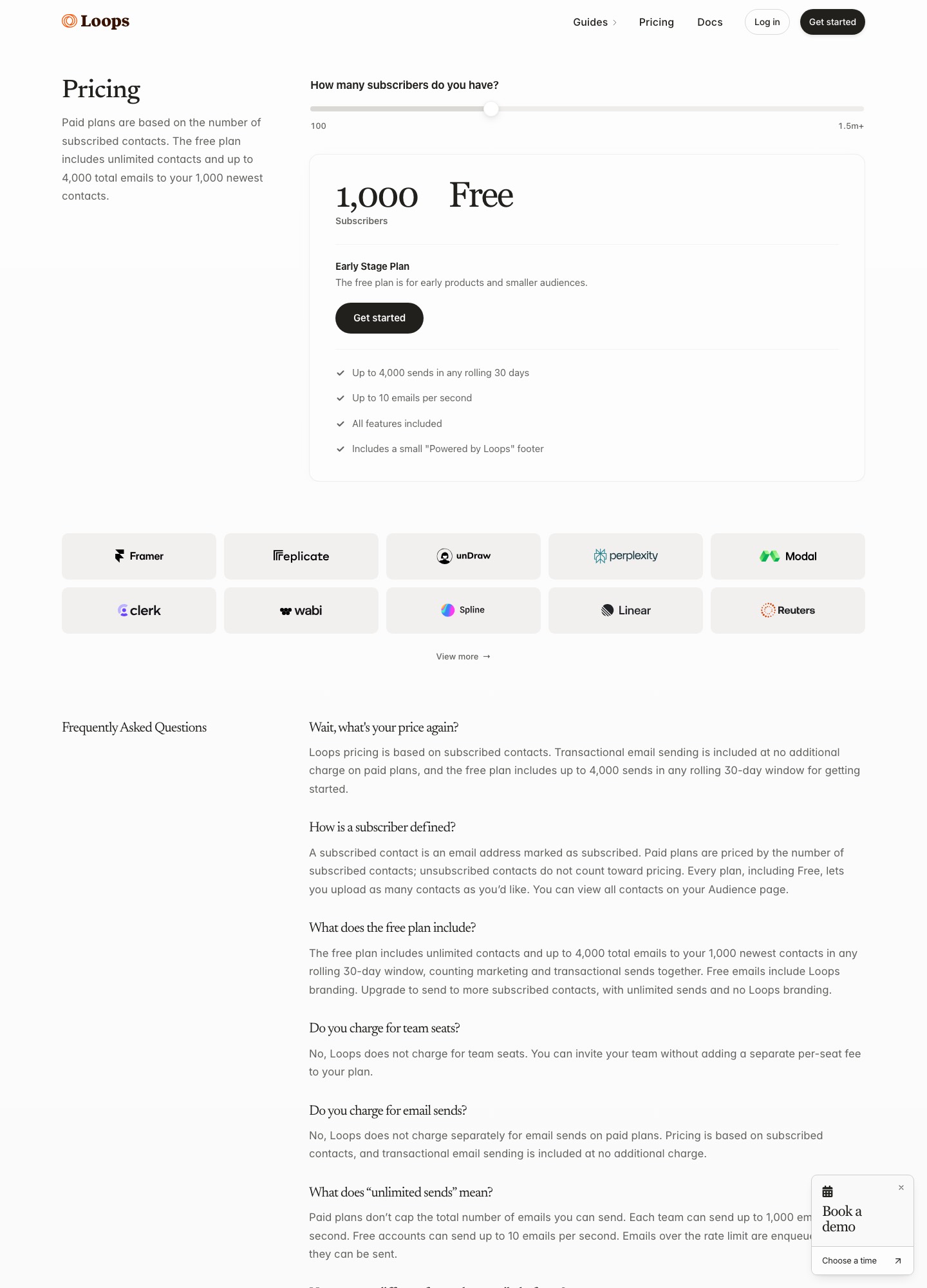
Loops' free plan allows unlimited contacts but only up to 4,000 sends in any rolling 30 days to your 1,000 newest contacts, with a small "Powered by Loops" footer and 10 emails a second. Paid plans are priced by subscribed contacts only: unsubscribed contacts do not count, there is no per-seat charge, and transactional email is included. The slider on its pricing page showed about $48 at 4,788 subscribers, $99 at 9,998, $198 at 24,339, $249 at 49,989 and $799 at 199,878, with custom pricing above 1.5 million. Because every feature is on every plan, an alternative has to win on something other than "more features per tier."
Three problems push people out. The first is the slope of the price at 50,000 contacts and beyond, especially if a big share of the list is inactive but still subscribed. The second is data shape: Loops models people and their events, and teams selling to organisations often want a company record with its own properties and segments. The third is channels, since the pages we read describe email, not push or in-app messages. Your reason decides your shortlist.
Cost at three list sizes
| Audience | Loops | MailerLite Comfort | Kit Creator | Userlist Basic | Encharge Growth | Customer.io |
|---|---|---|---|---|---|---|
| About 5,000 | $48 | $49 | $75 | $149 (includes up to 10,000 users) | $179 | $100 (Essentials, 5k profiles) |
| About 10,000 | $99 | $89 | $116 | $149 | $249 | Not published; Premium from $1,000 |
| About 25,000 | $198 (at 24,339) | $179 | $166 | $229 at 18,000; $369 at 32,000 | $389 | Not published |
All figures are monthly list prices from each vendor's pricing page; Kit's are its yearly-billed monthly rates, and Customer.io's Essentials plan is listed as billed monthly. Mind the units: Loops and Encharge count subscribers, Userlist counts all users in the account, Customer.io counts people and objects as profiles, and Kit and MailerLite count subscribers by tier. A list that is mostly unsubscribed will look much cheaper on Loops than on Userlist, which counts every user.
The alternatives, one by one
Customer.io: when events and channels outgrow email
Customer.io's Essentials plan starts at $100 a month for 5k profiles and includes the visual workflow builder, two object types and one million emails a month. Its channel list is wider than Loops': push and in-app are unlimited, and WhatsApp and LINE are native. It is the logical next step when your journeys depend on many behavioural events and several channels. The price after 5,000 profiles is not published, and Premium starts at $1,000 a month billed yearly, so budget a conversation with sales. Companies that raised under $10M can apply to its Startup Program for twelve months free. See Customer.io alternatives for the other direction.
Userlist: when the company is the unit
Userlist's Basic plan is $149 a month for up to 10,000 users, adding $10 per extra 1,000, and it includes segments for users and companies, company accounts, in-app messages and transactional email. If you sell to teams and want a campaign that fires when an account crosses a threshold, this is the nearest SaaS-native alternative to Loops. It counts all users, active or not, so clean the list before importing. Compare it with Intercom in Userlist vs Intercom.
Encharge: visual flows with CRM sync
Encharge Growth is $99 a month for up to 2,000 subscribers and $249 at 10,000, with unlimited flows and team members. Integrations with Stripe and Chargebee are on Growth; HubSpot, Salesforce, Segment and transactional email require Premium ($159 at 2,000, $399 at 10,000). Choose it if a marketer will own the flows and sales uses HubSpot. It is not cheaper than Loops at any size we checked, so the reason to move is the CRM link. The matchup against Customer.io is in Encharge vs Customer.io.
MailerLite and Kit: when the job is mostly newsletters
MailerLite Comfort is $89 a month at 10,000 subscribers and $179 at 25,000, and its free plan holds 250 subscribers and 2,500 emails a month. Kit's free plan is more generous on list size, up to 10,000 subscribers, though automations and sequences start on Creator at $116 for 10,000. Both are strong at landing pages and audience building, and neither pricing page describes product-event triggers, so use them if your emails are mostly editorial rather than in-app. See ConvertKit vs Mailchimp and Brevo vs MailerLite.
Bento: when you also want a transactional line item
Bento's Marketing Platform is $29 a month for up to 5,000 active users, with unlimited marketing sends and a 30-day free trial, and its separate Transactional Email product starts at $5 for up to 12,500 emails. It is priced on active users rather than every contact, which can help a list with a lot of dormant addresses. The compromise is two meters, one for marketing and one for transactional.
Resend and Postmark: when the real problem is transactional mail
If password resets and receipts are the pain, a transactional sender may fix it better than a full platform. Resend lists a free plan of 3,000 emails a month (100 a day) and Pro at $20 a month for 50,000 emails. Postmark's Basic plan is $15 a month for 10,000 emails, with its free plan capped at 100 a month. Neither replaces lifecycle sequences, so pair one with a marketing tool.
Intercom: when support context should shape onboarding
Intercom prices per seat ($19 for Essential, $85 for Advanced, $132 for Expert per seat per month) plus usage, and outbound email is charged per bulk email sent. It makes sense when support conversations should pause or change onboarding messages, not as a straight Loops replacement.
If you run a SaaS with billing-triggered email: Sequenzy prices by email volume instead of contacts, with a free plan of 2,500 emails a month and $19 a month for 15,000 emails. Its pricing page lists Stripe, Paddle and Lemon Squeezy integrations. Compare its billing-event triggers against Loops' before choosing.
When to stay on Loops
Stay if your list is under 10,000, your triggers fit the events your app already sends, and your team likes having transactional and marketing email on one plan. At that size Loops is the cheapest SaaS-native option on this page, and a migration costs you the work of rebuilding every workflow and re-testing delivery. The case for leaving is a specific blocker, such as the need for company-level segmentation, a CRM sync or a second channel, not a general wish for a bigger tool.
Migration notes
Start by listing each Loops workflow with its trigger event, delays, branches and exit rules. Export subscribed contacts with every property, export mailing lists, and keep the exact event names your app sends, because your product code will need to point at the new tool's ingest API. Transactional templates built in MJML can usually be reused. Run the new platform in parallel on one workflow, such as a trial-ending reminder, while Loops keeps sending the rest. Only cut over DNS and sending-domain authentication after your test contacts see correct sends and unsubscribes.
FAQ
Why do teams look for a Loops alternative?
The usual triggers are cost at larger list sizes, a need for company-level data, or more channels than email. Loops prices paid plans by subscribed contacts, so its page shows about $99 a month near 10,000 subscribers and about $799 near 200,000. Teams that outgrow a contact-based bill, or that need account objects and push messages, start comparing Customer.io, Userlist and similar tools.
Is there a cheaper alternative to Loops at 10,000 contacts?
On list prices read from each vendor page on October 7, 2026, MailerLite Comfort is $89 a month at 10,000 subscribers against about $99 for Loops, and Kit Free costs nothing at that size if you can do without automations. Encharge Growth ($249) and Userlist Basic ($149) cost more but are built around SaaS data. Price differences are small until you add features you actually need.
Can I keep Loops for transactional email and use another tool for marketing?
You can, and some teams do. Loops includes transactional sending in paid plans at no extra charge, so the reason to split is deliverability isolation or a developer preference rather than price. If you split, send receipts and password resets from a dedicated sender such as Resend or Postmark and keep lifecycle sequences in the marketing tool.
What should I export from Loops before switching?
Export your subscribed contacts with every contact property, your mailing lists and the event names your app sends. Copy transactional templates too: Loops lets you bring your own MJML, so those are portable. Workflows have to be rebuilt by hand in the new tool, which is why the first migration step should be writing down each workflow’s trigger, delays and exit rules.
Also read the alternatives hub, Mailchimp alternatives, Resend alternatives and SaaS comparisons. See our evaluation method.