Alternatives guide · Prices checked October 7, 2026
Resend Alternatives for SaaS Email: Prices and Fit
Pick Amazon SES if your volume is high and someone on your team will run the plumbing, Postmark if you would rather pay more per email for a mature transactional-only product, Mailgun if you need inbound routing or EU hosting, and SendGrid if transactional mail and campaigns must sit with one vendor. Mailtrap is the pick if you also want a test inbox for staging. Resend itself is hard to beat up to 50,000 emails a month at $20, so the case for leaving is usually a feature it lacks rather than its price.
Resend is built for teams that send email from code, so the reasons to look elsewhere are narrower than for a general marketing platform: a volume where the per-email rate starts to matter, a need for channels or campaigns beyond transactional mail, or a wish for a vendor with a longer track record. The sections below sort the alternatives by which of those you are trying to fix, using the prices on each vendor's own pricing page. Postmark has a guide of its own at Postmark alternatives.
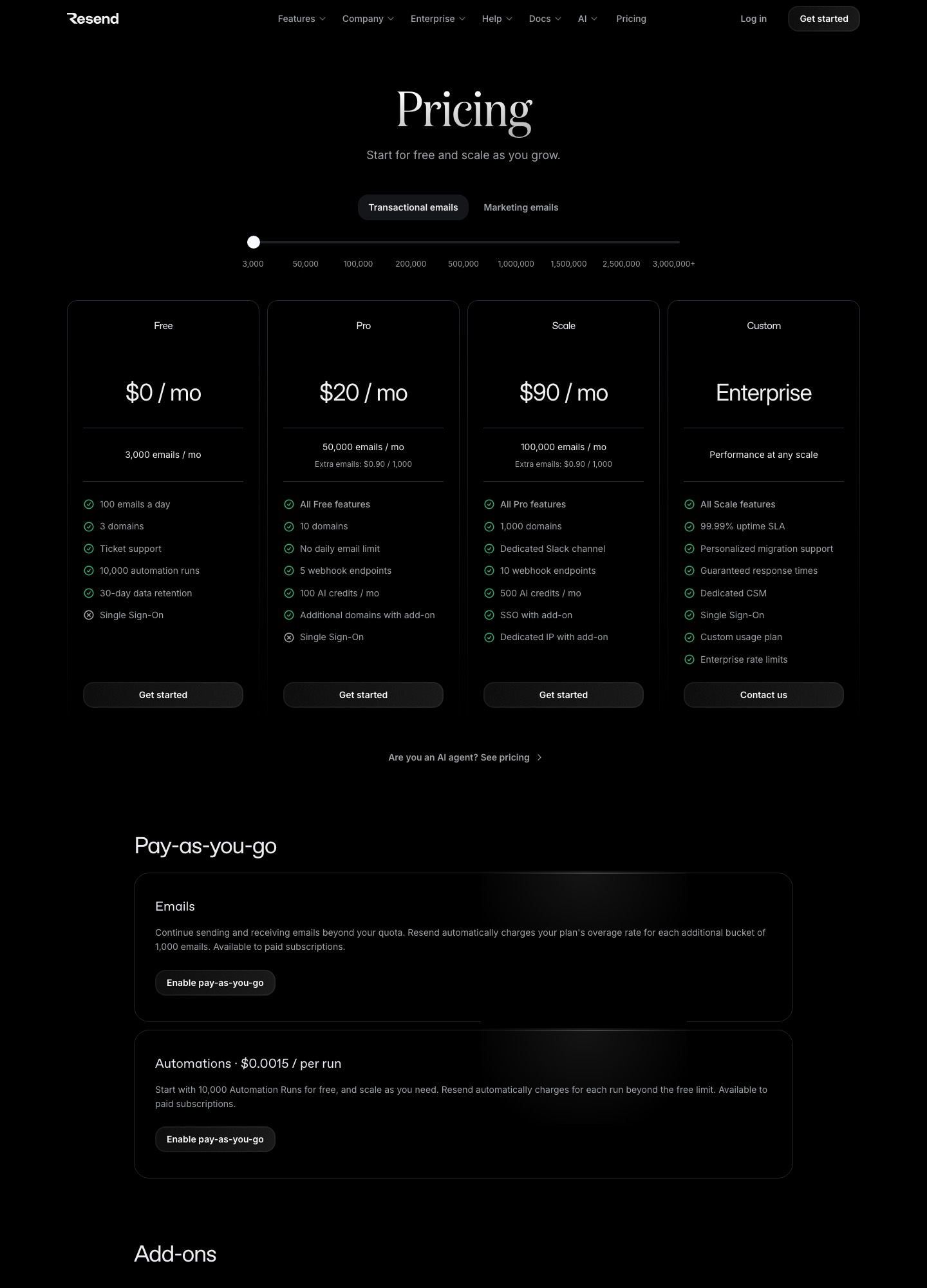
What you are leaving: Resend in numbers
Resend's pricing page has a Transactional tab and a Marketing tab, and the figures here come from the Transactional tab. Free is $0 for 3,000 emails a month, capped at 100 a day, with 3 domains, 10,000 automation runs and 30-day data retention. Pro is $20 a month for 50,000 emails with no daily limit, 10 domains and five webhook endpoints, and extra emails are $0.90 per 1,000. Scale is $90 for 100,000 emails with 1,000 domains, ten webhook endpoints and a dedicated Slack channel, while SSO and a dedicated IP are add-ons. Enterprise is custom. Pay-as-you-go lets paid plans keep sending past the quota at the plan's overage rate, and automation runs beyond the free allowance cost $0.0015 each. The slider runs from 3,000 emails up to 3,000,000 and beyond, and each plan steps up by volume along it: Pro reads $20 at 50,000 emails and $35 at 100,000, while Scale reads $90 at 100,000 and $160 at 200,000, with extra emails at $0.80 per 1,000 at that volume.
That structure explains most departures. Between 50,000 and 100,000 emails you can stay on Pro, which reads $35 at 100,000 on the slider against $90 for Scale at the same volume, so the step to Scale is a purchase of features rather than volume. Below 50,000 emails there is no cheaper paid tier, so a product sending 8,000 emails a month pays $20, where Postmark Basic, Mailgun Basic and Mailtrap Basic each charge $15 for 10,000. And the Free plan's 100-a-day cap rules out any load test of staging mail.
Cost at 10,000, 50,000 and 100,000 emails a month
| Sender and plan | 10,000 a month | 50,000 a month | 100,000 a month |
|---|---|---|---|
| Resend Pro | $20 | $20 | $35 (Pro on the slider; Scale is $90) |
| Postmark Basic | $15 | $15 + 40 × $1.80 = $87 | $15 + 90 × $1.80 = $177 |
| Mailgun | $15 (Basic) | $35 (Foundation) | $90 (Scale) |
| Mailtrap | $15 (Basic) | $15 + 40 × $1.00 = $55 | $85 (Business) |
| SendGrid | Selector starts at 50,000 | Essentials from $19.95 | Essentials from $19.95, Pro from $89.95 |
| SparkPost | Free tier is 1,000 a month | Startup from $15 | Startup from $15, Growth from $80 |
| Amazon SES Essentials | 10 × $0.16 = $1.60 | 50 × $0.16 = $8.00 | 100 × $0.16 = $16.00 |
All figures are US-dollar list prices read on October 7, 2026. Rows with a formula are the plan price plus the listed per-1,000 overage, so they compare rates and are not quotes; Resend's 100,000 figure is instead the slider reading on its pricing page. SendGrid's and SparkPost's amounts are starting prices for ranges of volume (50,000 to 100,000 emails for SendGrid Essentials and SparkPost Startup), and SendGrid's page adds that taxes and overages may apply. Resend and Mailtrap both describe volume as sending plus receiving, so a product that gets a lot of inbound mail should count it.
If cost per email is the problem
Amazon SES
On Essentials, SES charges $0.16 per 1,000 emails, and new accounts begin there from July 21, 2026 unless they choose another plan. Pro is $0.22 per 1,000 plus $105 per account per region each month, and Enterprise is $0.23 plus $500. An eligible new AWS customer can claim up to $200 in credits, and the page describes a free plan lasting six months after account creation. It is the lowest figure in the table by a distance, and it comes with the most assembly: SES works with Amazon SNS and CloudWatch for events and metrics, so someone on your team owns that wiring. It suits teams already running on AWS.
Mailtrap
Mailtrap's Free plan is 4,000 emails a month (150 a day), Basic is $15 for 10,000 with overage at $1.00 per 1,000, and Business is $85 for 100,000 with a dedicated IP and 15-day log retention. Its Email Sandbox and Email Marketing products are priced separately, each with a free tier. The sandbox is the reason to look: a team that wants staging mail to land in a test inbox rather than real mailboxes gets that and a production sender from the same vendor.
Mailgun
Mailgun's Foundation plan is $35 for 50,000 emails and Scale is $90 for 100,000, the same $90 as Resend Scale for the same 100,000 emails. Each lists a free first month, and Free is 100 emails a day. The extras are inbound routing, email validations (Scale includes 5,000), dedicated IPs and a choice of US or EU hosting, plus log retention that grows with the plan: five days on Foundation and 30 on Scale. Choose it if inbound parsing or EU data residency is the reason you are looking.
SparkPost
SparkPost lists a Free plan of 1,000 emails a month (50 a day), Startup from $15 for 50,000 to 100,000 emails, and Growth from $80 for 100,000 to 2.5 million, with dedicated IPs as an add-on. At 50,000 emails the Startup entry price sits below Resend's $20, so it is the one fixed-price rival that can undercut Pro. There is no small plan between the Free and Startup tiers.
If you want a more established transactional product
Postmark
Postmark costs more per email than Resend: Basic is $15 for a base of 10,000 emails with $1.80 per extra 1,000, Pro is $16.50 ($1.30 extra) and Platform is $18 ($1.20 extra), and its free plan is 100 emails a month against Resend's 3,000. At 50,000 emails the list-rate arithmetic gives $66 to $87 against Resend's $20. What the extra money buys is its focus: its Basic plan lists 45-day data retention, and inbound email processing begins on Pro. It is the answer when delivery logs and a transactional-only product matter more than the bill. The full comparison is in Postmark alternatives.
SendGrid
SendGrid's Email API gives a 60-day trial of 100 emails a day, then Essentials from $19.95 and Pro from $89.95 with dedicated IPs included. Its Marketing Campaigns product is separate: a free plan of 2,000 contacts and 6,000 emails a month, then Basic from $15 and Advanced from $60. Choose it when the same vendor must carry application mail and newsletters. Choose something else if you want a permanent free tier, since its free allowance is the trial.
If you need more than email sending
MailerSend is the closest like-for-like with extras: Free is 500 emails a month, Hobby is $6.30 a month billed yearly for 5,000 emails, Starter is $31.50 for 50,000 and Professional is $99 for 50,000 plus 150 SMS a month, and it sells an SMS API and a WhatsApp API add-on. At 50,000 emails it costs $11.50 more than Resend Pro, so pick it for SMS, not for price. Knock sits a layer above all of these: it is a notification-orchestration product that decides between channels and respects each user's preferences, and it is worth a look only if email is one of several channels you send on. We quote no price for it here.
If the gap is lifecycle campaigns, run a second tool beside Resend instead of replacing it. Customer.io Essentials starts at $100 a month, billed monthly, for 5k profiles and up to one million emails a month. Loops has a free plan of 4,000 sends in a rolling 30 days to your 1,000 newest contacts and charges $99 a month at 9,998 subscribers, with transactional sending included. Brevo's Starter plan begins at $9 a month and Standard at $18, and Bento's Marketing Platform is $29 a month for up to 5,000 active users. Read Customer.io alternatives and Loops alternatives for the trade-offs of each.
If you run a SaaS and want billing events to trigger email: Sequenzy bills by monthly email volume with unlimited contacts: free for 2,500 emails, then $19 for 15,000, $29 for 30,000 and $49 for 60,000. Its pricing page lists Stripe, Paddle and Lemon Squeezy integrations. Compare its event depth, exports and team permissions against your stack like any other tool here.
When to stay on Resend
Stay if you send between roughly 3,000 and 50,000 emails a month from code and want one flat price. At $20, only SES, SparkPost's Startup tier ($15) and SendGrid Essentials ($19.95, a starting price) list less at 50,000 emails, and moving to any of them means new DNS records, a new webhook consumer and a test period for a saving of a few dollars or a different set of problems. Leave when you hit a specific wall: a daily cap on Free, inbound mail, a region, SMS or a lifecycle layer that Resend does not provide.
Migration notes
- Templates. Anything you render in your own code, whether React components, MJML or plain HTML strings, can be sent through any other sender once it is HTML. Templates stored in Resend's dashboard have to be recreated.
- Webhooks. Resend registers webhook endpoints on paid plans, five on Pro and ten on Scale. List every service that consumes them and which event types it reacts to, then map those to the new sender's event names before cutover.
- Domains. Free allows 3 domains and Pro 10. Add the new sender's DNS records next to Resend's, send a test from each, and drop Resend's records only after the last stream has moved.
- Dedicated IP. If you bought Resend's dedicated-IP add-on on Scale, expect to warm the replacement address gradually, as you would with SendGrid Pro, Mailtrap Business or an SES add-on.
Related guides
The alternatives hub lists every tool this site covers. For picking by workload, see email tools for API products and transactional email tools for SaaS, and read our evaluation method for how prices and screenshots are captured.
FAQ
Is Resend Scale at $90 worth it over Pro at 100,000 emails?
Not for price alone. Resend's pricing slider, read on October 7, 2026, shows Pro at $35 a month for 100,000 emails and Scale at $90 for the same 100,000, so the volume alone does not justify the step up. The extra money buys other things: its page lists 1,000 domains, a dedicated Slack channel, ten webhook endpoints and add-ons for SSO and a dedicated IP. Pick Scale for those features, not for the email allowance.
What do I lose by moving from Resend to Amazon SES?
You lose the finished product around the API. SES charges $0.16 per 1,000 emails on Essentials, so 100,000 emails costs $16 against $35 on Resend Pro at that slider volume, but event handling through Amazon SNS, reporting in CloudWatch and any alerting have to be set up by someone on your team. The saving is real only if that person already exists and the time is not billed to a product roadmap.
Which Resend alternative suits a team that does not write much code?
MailerSend and Brevo are the two here with a point-and-click side. MailerSend sells Hobby at $6.30 a month billed yearly for 5,000 emails and an SMS API on top, and Brevo has a Free plan of 300 emails a day plus Starter from $9 a month. Both are weaker fits if your templates already live in a code repository, since you would be re-creating them in a visual editor.
What should I move first when leaving Resend?
Start with the stream where a late or missing email costs you least, such as a weekly digest or product notice, and keep password resets and receipts on Resend until the new sender has delivered a few weeks of mail cleanly. Keep both senders authenticated on your domain during that period. Resend Free allows 3 domains and Pro allows 10, so confirm you are not paying for domain slots you no longer use.