Alternatives guide · Prices checked October 7, 2026
Postmark Alternatives for SaaS Email: Prices and Fit
Pick Resend if you want a developer-friendly API with a bigger free plan and a lower overage rate; Amazon SES if you will run more of the plumbing yourself to pay cents per thousand emails; and Mailgun or Mailtrap if you want a like-for-like $15 plan with different extras. Reach for Customer.io, Loops or Brevo only when the real gap is lifecycle campaigns rather than delivery. Postmark stays the easy choice when your mail is receipts and password resets, volume sits near 10,000 a month, and nobody wants to own a sender.
Most people looking for a Postmark alternative have one of three reasons: the bill climbs faster than expected once volume passes the plan, the free plan is too small to test on, or they want product-triggered campaigns somewhere. This guide goes through each credible replacement with the prices on its own pricing page and the situation in which it beats Postmark. If you are weighing the other developer-first sender, read the Resend alternatives guide as well.
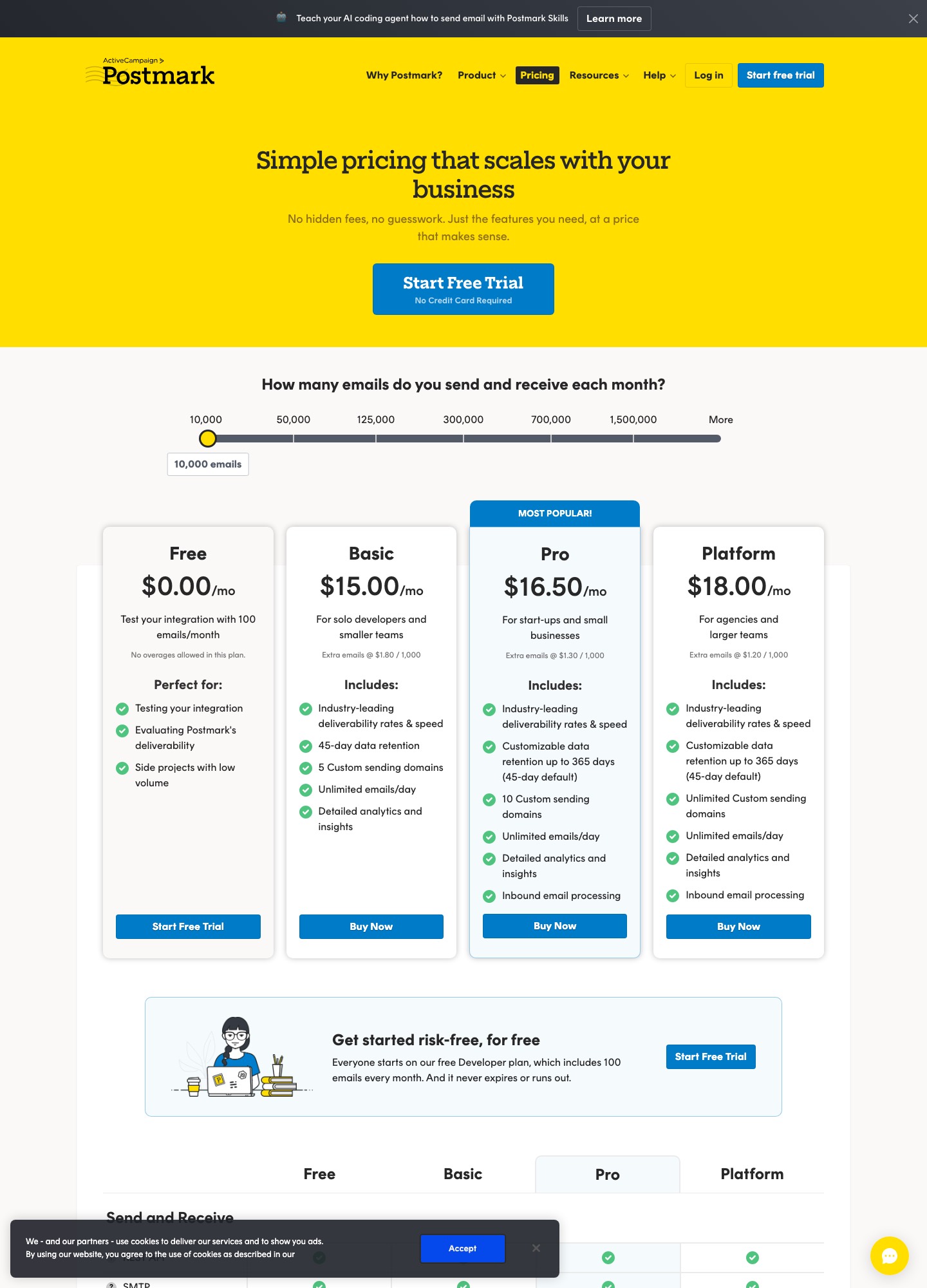
What you are leaving: Postmark in numbers
Postmark's pricing page lists four plans. Free is $0 and includes 100 emails a month, with no overages allowed. Basic is $15 a month, Pro is $16.50 and Platform is $18, and each starts at 10,000 emails a month. Extra emails cost $1.80 per 1,000 on Basic, $1.30 on Pro and $1.20 on Platform. The slider at the top of the page opens at 10,000 and steps through 50,000, 125,000, 300,000, 700,000 and 1,500,000 emails, and the question above it asks how many emails you send and receive, so inbound mail counts toward your volume. The comparison grid lists inbound email processing from Pro upward.
Two numbers push most teams out. The first is the $1.80 overage rate on the cheapest paid plan, which is double Resend's $0.90 per 1,000 and more than eleven times Amazon SES's $0.16. The second is the 100-email free plan: enough to prove an integration works, not enough to run a staging environment with real test traffic. What teams rarely complain about is the job Postmark was built for, getting application mail out with logs you can read. Its Basic plan lists 45-day data retention, which is worth remembering below, because several cheaper senders keep logs for a day.
Cost at 20,000 and 50,000 emails a month
| Sender and plan | Plan price | Included emails | At 20,000 a month | At 50,000 a month |
|---|---|---|---|---|
| Postmark Basic | $15 | 10,000 | $15 + 10 × $1.80 = $33 | $15 + 40 × $1.80 = $87 |
| Postmark Platform | $18 | 10,000 | $18 + 10 × $1.20 = $30 | $18 + 40 × $1.20 = $66 |
| Mailtrap Basic | $15 | 10,000 | $15 + 10 × $1.00 = $25 | $15 + 40 × $1.00 = $55 |
| Mailgun Basic / Foundation | $15 / $35 | 10,000 / 50,000 | $15 + 10 × $1.80 = $33 | $35 (Foundation) |
| Resend Pro | $20 | 50,000 | $20 | $20 |
| SendGrid Essentials | from $19.95 | 50,000 to 100,000 in the selector | Selector starts at 50,000 | from $19.95 |
| MailerSend Starter | $31.50 (billed yearly) | 50,000 | $31.50 | $31.50 |
| Amazon SES Essentials | $0.16 per 1,000 | None, pay as you go | 20 × $0.16 = $3.20 | 50 × $0.16 = $8.00 |
All figures are list prices in US dollars from each vendor's pricing page on the check date. The Postmark, Mailgun and Mailtrap rows are the plan price plus the listed per-1,000 overage, so they show rates rather than quotes: Postmark's slider may quote a different figure at a given volume, and Mailtrap counts sending and receiving together. MailerSend's figure is its yearly-billed monthly rate. SES charges for sending only, with no platform around it, which is why it is the cheapest row and also the one that asks most of you. Against Postmark Basic, Resend Pro at $20 becomes the cheaper option once you pass roughly 12,800 emails a month on these rates ($15 plus 2.8 thousand extra emails at $1.80 comes to about $20).
The alternatives, one by one
Resend: the closest developer-first replacement
Resend's Free plan is $0 for 3,000 emails a month, capped at 100 a day, with 3 domains. Pro is $20 a month for 50,000 emails, with extra emails at $0.90 per 1,000, and Scale is $90 for 100,000. Pro removes the daily cap and lists five webhook endpoints (ten on Scale), and the Free plan includes 10,000 automation runs. Its pricing page has separate Transactional and Marketing tabs, and the numbers here come from the Transactional tab. Choose Resend if your team writes email templates in code and wants a larger free tier and cheaper overage than Postmark has. Expect to rebuild any templates you keep in Postmark's dashboard. For the reverse question, see Resend alternatives.
SendGrid: when sending volume and campaigns share a vendor
SendGrid's Email API is priced on Twilio's site: a free trial of 100 emails a day for 60 days, Essentials from $19.95 a month for 50,000 to 100,000 emails in the plan selector, and Pro from $89.95 for 100,000 to 2,500,000 emails with dedicated IPs included. Its separate Marketing Campaigns product has a free plan of up to 2,000 contacts and 6,000 emails a month, Basic from $15 and Advanced from $60. That split is the draw, since transactional mail and campaigns can live with one vendor, though on two meters. For a small team the catch is the free allowance, which is a 60-day trial rather than a permanent plan, and the pricing page notes that taxes and overages may apply on top of the starting prices.
Mailgun: the same $15 entry, with different extras
Mailgun's Basic plan is $15 a month for 10,000 emails, the same entry price as Postmark Basic and the same $1.80 starting overage figure. Foundation is $35 for 50,000 emails and Scale is $90 for 100,000, and both list a free first month. The Free plan is 100 emails a day. What you gain is inbound routing, email validations and a choice of US or EU hosting regions. What you give up is log depth: Mailgun lists one day of log retention on Free and Basic, five days on Foundation and 30 days on Scale, against 45 days on Postmark Basic. If your support team opens delivery logs to answer "where is my reset email", that difference matters more than the price.
Amazon SES: the cheapest per email, the most to run
Amazon SES charges $0.16 per 1,000 emails on its Essentials plan, which is where new accounts start from July 21, 2026 unless they select another. Pro is $0.22 per 1,000 plus $105 per account per region per month, and Enterprise is $0.23 per 1,000 plus $500 per account per region per month. Eligible new AWS customers can receive up to $200 in credits, and the page describes a free plan lasting six months after account creation. At 50,000 emails a month the sending bill is $8, which is why SES comes up whenever volume is high. It is sending infrastructure rather than a finished product: it works with Amazon SNS and CloudWatch for events and metrics, so event handling, reporting and alerting are yours to wire up. Choose it if you already run on AWS and someone will own it.
Mailtrap: a larger free tier and a test inbox next door
Mailtrap's Email API plans are Free at $0 for 4,000 emails a month (150 a day), Basic at $15 for 10,000, Business at $85 for 100,000 and Enterprise at $750 for 1,500,000. Overage on Basic is $1.00 per 1,000, and Business adds a dedicated IP and 15-day log retention. Mailtrap prices Email API and SMTP, Email Sandbox and Email Marketing as three separate products, each with its own free tier, so a team that wants a test inbox for staging mail and a production sender can get both from one vendor. Volume counts sending and receiving together, the same way Postmark's slider does.
MailerSend: a low entry price and a steep step to 50,000
MailerSend's Free plan is 500 emails a month. Hobby is $6.30 a month ($75.60 billed yearly) for 5,000 emails with 5 seats and one domain, Starter is $31.50 a month ($378 billed yearly) for 50,000 emails and 10 domains, and Professional is $99 a month ($1,188 billed yearly) for 50,000 emails plus 150 SMS a month, with unlimited users and domains. It also sells an SMS API and a WhatsApp API add-on, so it suits a small product that wants email and SMS from one account. At 50,000 emails Starter costs $11.50 more than Resend Pro, so it is not the price pick.
SparkPost: a big gap between free and paid
SparkPost's Free plan is 1,000 emails a month with a 50-a-day cap. Startup is from $15 a month for 50,000 to 100,000 emails and Growth is from $80 for 100,000 to 2.5 million, with dedicated IPs as an add-on. The tiers on its page jump from 1,000 included emails straight to 50,000, so it fits a team that has already outgrown Postmark's free plan and wants headroom, and it fits less well if you need something in between. Extra sends are billed separately.
When the gap is campaigns, not delivery
If what you actually miss is lifecycle email, such as onboarding sequences and trial-ending reminders sent from product events, a second tool beside Postmark usually beats a sender swap. These are the ones this site covers, with the prices on their own pages.
Customer.io
Essentials starts at $100 a month, billed monthly, for 5k profiles and up to one million emails a month, and Premium starts at $1,000 a month billed yearly. Its page also lists push, in-app and WhatsApp. Companies that raised under $10M can apply for a year free through its Startup Program. See Customer.io alternatives for the other direction.
Loops
The free plan allows up to 4,000 sends in any rolling 30 days to your 1,000 newest contacts. Paid plans scale by subscribers, $99 a month at 9,998 and $249 at 49,989, and transactional sending is included at no extra charge. Our Loops alternatives page covers where it stops fitting.
Brevo and Bento
Brevo's Free plan sends 300 emails a day, Starter begins at $9 a month and Standard at $18, both from 5,000 emails a month, and its page lists transactional email alongside marketing automation. Bento prices the two jobs separately: Marketing Platform is $29 a month for up to 5,000 active users with unlimited marketing sends, while Transactional Email is free for the first 100 emails a month and starts at $5 for up to 12,500.
If you run a SaaS with billing-triggered email: Sequenzy prices by email volume instead of contacts, with a free plan of 2,500 emails a month and $19 a month for 15,000 emails. Its site describes one platform for transactional and marketing email, and its pricing page lists Stripe, Paddle and Lemon Squeezy integrations. Compare its delivery tooling against Postmark's before choosing.
When to stay on Postmark
Stay if you send under about 12,000 emails a month, mostly one stream of receipts, resets and alerts, and your team reads delivery logs often. At that size the saving from moving is a few dollars a month, against the work of re-verifying domains, rebuilding templates and re-testing every webhook. The case for leaving is a specific number or gap: overage at $1.80 per 1,000 on a growing volume, a free plan too small for staging, or a campaign tool you need anyway.
Migration notes
- List every message type Postmark sends today, with its template, its sender signature and whichever service consumes its bounce and complaint webhooks.
- Add the new sender's DNS records alongside Postmark's instead of replacing them, then send a test from each so you can compare headers and inbox placement.
- Export Postmark's suppressions and import them into the new sender before its first live send.
- Move one low-risk stream first, such as product notifications, and keep password resets on Postmark until a week of new logs matches the old ones.
- If you buy a dedicated IP (SendGrid Pro includes them, Mailtrap Business lists one, Mailgun and SES sell them), plan a warm-up rather than switching full volume on day one.
Related guides
Start from the alternatives hub for every tool covered here. For choosing by job, read transactional email tools for SaaS and deliverability tools; for how we read prices and capture screenshots, see our evaluation method.
FAQ
Is there a cheaper alternative to Postmark?
On list prices read on October 7, 2026, yes at almost every volume above 10,000 emails a month. Postmark Basic is $15 for a base of 10,000 emails and charges $1.80 per extra 1,000, while Resend Pro is $20 for 50,000 emails and Amazon SES Essentials is $0.16 per 1,000. At 10,000 emails a month Postmark, Mailgun and Mailtrap are all $15, so the saving only shows up as you grow.
Which Postmark alternative has the best free plan?
Among the dedicated senders in the cost table above, Mailtrap lists the largest permanent free tier, at 4,000 emails a month with a 150-a-day cap. Resend gives 3,000 a month (100 a day), SparkPost 1,000 a month, MailerSend 500 a month, and Mailgun 100 a day. Postmark Free is 100 emails a month with no overages allowed, so it works for testing an integration and little else.
Can I keep Postmark for receipts and use another tool for lifecycle email?
Yes, and it is the most common outcome when the gap is campaigns rather than delivery. Customer.io, Loops, Brevo and Bento all send email from product events, and none of them requires you to move password resets or invoices. Keep the transactional sender as it is until the new tool has run alongside it for a few weeks without surprises in logs or bounces.
What should I export from Postmark before switching?
Export your suppression lists first, covering hard bounces, spam complaints and manual unsubscribes, because a new sender starts with none of that history and will happily mail addresses Postmark already blocked. Then copy each template and note which sender signatures and domains use it. Webhook endpoints need new URLs and may need new event names, so list every consumer of those events too.