Alternatives guide · Prices checked October 7, 2026
Userlist Alternatives for SaaS Email: Prices and Fit
Pick Customer.io if your journeys depend on many product events and channels beyond email; Encharge if a marketer will own visual flows and sales works in HubSpot or Salesforce; HubSpot if the company record belongs in a CRM; Intercom if support conversations should steer onboarding; and Loops or MailerLite if Userlist is more tool than you use. Userlist itself is the nearest fit when you message accounts rather than just people. Basic is $149 a month for up to 10,000 users, and the case for leaving is usually the price per user or a missing channel.
Userlist is built for SaaS products where a customer is a company with several users, so a good alternative either keeps that shape or gives you a reason to give it up. This guide starts from what Userlist charges, then compares the destinations by what they bill on, because per user, per subscriber, per profile and per seat are not the same unit. For a head-to-head with one of them, see Userlist vs Intercom.
What you are leaving: Userlist in numbers
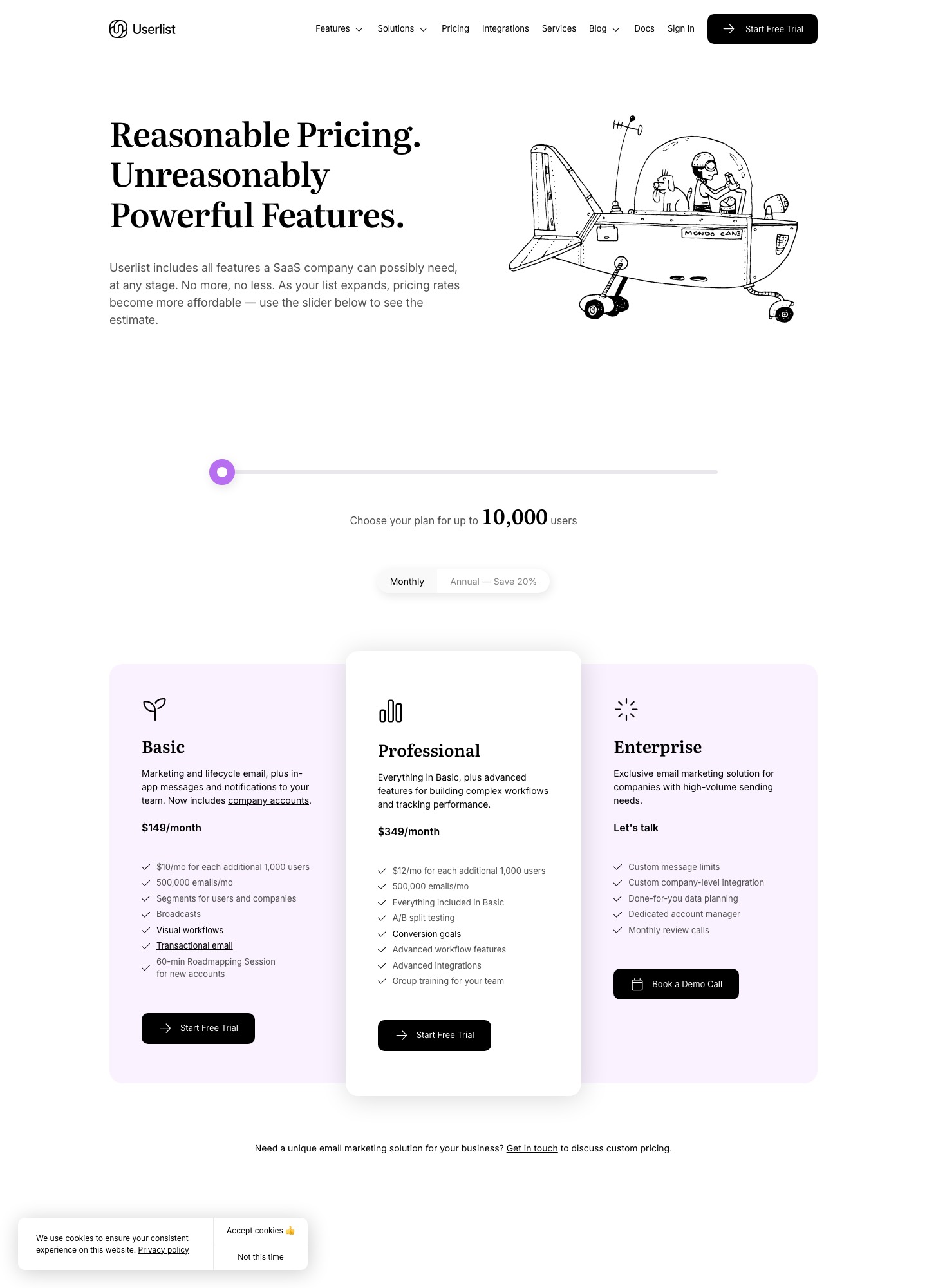
Userlist's pricing page sells two self-serve plans, both priced by the number of users. Basic is $149 a month for up to 10,000 users, plus $10 a month for each additional 1,000, and the page also quotes $229 at 18,000 users and $369 at 32,000. It includes marketing and lifecycle email, in-app messages, and segments for users and companies. Professional is $349 a month for up to 10,000 users, plus $12 for each additional 1,000, and adds A/B split testing, conversion goals and advanced workflow features. Enterprise has custom message limits and custom pricing.
Three pressures push teams off it. Price per user is the first: the entry plan is $149 even for a young product, where lighter tools start far lower. Loops has a free plan. MailerLite Comfort is $49 at 5,000 subscribers. The second is that testing and goal tracking sit behind the $349 Professional plan. The third is scope, since the pricing page describes email and in-app messages, and teams that want push, WhatsApp or a support inbox in the same tool look elsewhere.
What each tool bills on, and what that costs
| Tool and plan | Billing unit | Prices read on October 7, 2026 |
|---|---|---|
| Userlist Basic | Users | $149 up to 10,000; $229 at 18,000; $369 at 32,000; $10 per extra 1,000 |
| Userlist Professional | Users | $349 up to 10,000; $12 per extra 1,000 |
| Encharge Growth | Subscribers | $99 at 2,000; $179 at 5,000; $249 at 10,000; $389 at 25,000 |
| Encharge Premium | Subscribers | $159 at 2,000; $269 at 5,000; $399 at 10,000; $649 at 25,000 |
| Customer.io Essentials | Profiles (people plus objects) | $100 for 5k profiles, billed monthly; Premium from $1,000, billed yearly |
| Loops | Subscribed contacts | Free to 4,000 sends in 30 days; $99 at 9,998; $249 at 49,989 |
| MailerLite Comfort | Subscribers | $49 at 5,000; $89 at 10,000; $179 at 25,000 |
| Drip | Active people plus email volume | $89 at 5,000; $154 at 10,000; $369 at 25,000 |
| Intercom | Seats plus usage | $19, $85 or $132 per seat a month; Fin at $0.99 per outcome |
| Bento Marketing Platform | Active users | $29 for up to 5,000 active users |
Take a product with 12,000 users in about 1,500 company accounts. Userlist Basic bills the 12,000 users: $149 + 2 × $10 = $169. Encharge bills subscribers, so 12,000 falls between its $249 reading at 10,000 and its $389 reading at 25,000. Customer.io counts people and objects together as profiles, so company records you model as objects use part of the allowance. Intercom ignores list size and charges per teammate seat, so three seats on Essential come to $57 a month and ten come to $190. Encharge, Drip and MailerLite figures are monthly list prices; Encharge also charges $100 for every 100,000 emails sent.
The alternatives, one by one
Customer.io: when events and channels outgrow Userlist
Customer.io's Essentials plan includes a visual workflow builder, two object types and one million emails a month, and Premium lists ten object types and custom profile volume. Object types are how it models things like companies or workspaces, so it is the nearest match on the pricing page to Userlist's company segments. Its page also lists push, in-app messaging and WhatsApp. The catch is the jump: Essentials is $100 for 5k profiles, and Premium starts at $1,000 a month billed yearly, so budget a sales conversation once you pass the first tier. Companies that raised under $10M can apply for twelve months free. Read Customer.io alternatives for the reverse direction.
Encharge: visual flows with a CRM link
Encharge Growth includes unlimited flows and team members, and Premium adds HubSpot, Salesforce and transactional email; its integration list also names Segment, Stripe and Chargebee. At 10,000 subscribers Growth is $249 and Premium $399, against Userlist Basic at $149 for 10,000 users, so Encharge is the more expensive move and the reason to make it is the CRM sync or a marketer-friendly builder. See Encharge alternatives and Encharge vs Customer.io.
HubSpot Marketing Hub: when the company record is the CRM
HubSpot's free tools include 2,000 marketing email sends a calendar month with HubSpot branding. Marketing Hub then lists Starter at $7 a month with up to 10 automated actions, Professional at $800 a month with unlimited automation, and Enterprise at $3,600, with lead scoring in the feature list. The step from Starter to Professional is the main story: serious automation is priced like a sales-team purchase, so HubSpot makes sense when sales already lives there and the company record has to stay in one place, not as a cheaper Userlist.
Intercom: when support context should shape onboarding
Intercom's Essential, Advanced and Expert plans are $19, $85 and $132 per seat per month, with a 14-day free trial, usage on top for its Fin agent at $0.99 per outcome, and email campaigns charged per bulk email sent. Choose it when support conversations should pause or redirect lifecycle messages. It is a messaging-and-support suite first, so it is rarely a straight replacement for Userlist's segments. The head-to-head is in Userlist vs Intercom.
Loops and MailerLite: when Userlist is more tool than you use
Loops has a free plan for up to 4,000 sends in any rolling 30 days to your 1,000 newest contacts, then charges by subscribed contacts, $99 at 9,998 and $249 at 49,989, with no seat fees and transactional sending included. Its pricing page describes contacts and does not mention the company-level segments that Userlist's Basic plan lists. MailerLite's Free plan covers 250 subscribers and 2,500 emails a month, and Comfort is $89 at 10,000 subscribers (Power is $129). Both are far cheaper than Userlist at 10,000, and both fit a product whose emails are mostly welcome series and announcements. See Loops alternatives.
Drip, ActiveCampaign, Brevo and Bento
Drip charges $154 a month at 10,000 people and $369 at 25,000, with a 14-day free trial and a Stripe integration in its list, so it fits a product with commerce-like billing events. ActiveCampaign's plans start at $15 (Starter), $49 (Plus), $79 (Pro) and $145 (Enterprise) a month at 1,000 contacts, billed annually, and suit sales-led follow-up. Brevo's Starter is from $9 and Standard from $18, both from 5,000 emails a month. Bento's Marketing Platform is $29 for up to 5,000 active users, priced on active rather than total users, which helps a list with many dormant accounts. Braze lists no self-serve price and bills on the volume of users engaging with your brand, so it belongs to teams with a dedicated lifecycle function.
If you run a SaaS with Stripe billing: Sequenzy is priced by emails with unlimited contacts, free for 2,500 emails a month and $19 for 15,000, and its site describes segments built from plan, MRR and engagement data. Compare its company-level segmentation against Userlist's before choosing.
When to stay on Userlist
Stay if your messaging really is account-shaped: campaigns that fire when a company crosses a usage threshold, or segments that mix user and company attributes. $149 for 10,000 users undercuts Encharge Growth at $249 and Drip at $154, and the cheaper options in the table, Loops at $99 and MailerLite at $89, bill contacts rather than companies. Leave when a specific blocker appears: a channel Userlist's page does not list, a CRM your sales team insists on, or A/B testing you cannot justify $349 for.
Migration notes
The hard part is the relationship between users and companies, not the templates. Export each user with its company identifier, export the companies with their plan data, and decide before importing how the new tool will hold that link: as objects in Customer.io, as a CRM association in HubSpot, or as a copied attribute on every user in a contact-first tool such as Loops or MailerLite. Rebuild segments by hand from a written list of their rules, flagging any rule that reads a company attribute. If you rely on Userlist's in-app messages, the replacement needs its own in-app channel, which Customer.io and Intercom both list on their pages. Run the new tool beside Userlist for one cohort, such as trial users in their first week, and pause the matching Userlist workflow the day the new one goes live so nobody gets both.
Related guides
The alternatives hub lists every tool this site covers. For choosing by workload, read email tools for customer journeys and segmentation tools for SaaS, then see Loops alternatives for a lighter-weight destination. Our evaluation method explains how prices are read and dated.
FAQ
How much does Userlist cost at 18,000 users?
Userlist's pricing page quotes Basic at $229 a month for up to 18,000 users, which matches its formula of $149 for the first 10,000 users plus $10 for each additional 1,000 (149 + 8 × 10). On Professional the same formula gives $349 + 8 × $12 = $445, using the $349 base for 10,000 users and $12 per extra 1,000. Enterprise has custom message limits and custom pricing.
Is there a free alternative to Userlist?
Several tools have a free tier, and each is limited in a different way. Loops allows 4,000 sends in any rolling 30 days to your 1,000 newest contacts, MailerLite Free covers 250 subscribers and 2,500 emails a month, and HubSpot's free tools include 2,000 marketing email sends a month with HubSpot branding. Customer.io has no free plan but gives companies that raised under $10M a year free through its Startup Program.
Which alternative handles companies as well as users?
Customer.io is the closest on a pricing page, since it lists object types (two on Essentials, ten on Premium) alongside people profiles. HubSpot carries company records inside its CRM, and Intercom ties conversations to the customer. Loops, MailerLite and Bento describe contacts or active users rather than company-level segments, so a campaign that fires when an account crosses a usage threshold would need the company attribute copied onto each user.
What should I export from Userlist before switching?
Export every user with all of its attributes and the identifier of the company it belongs to, then export the companies with their own attributes and plan data. Write down each segment's logic and the event names your product sends, because segments and workflows are rebuilt by hand in the new tool. If you use Userlist in-app messages, note each one and where it appears.